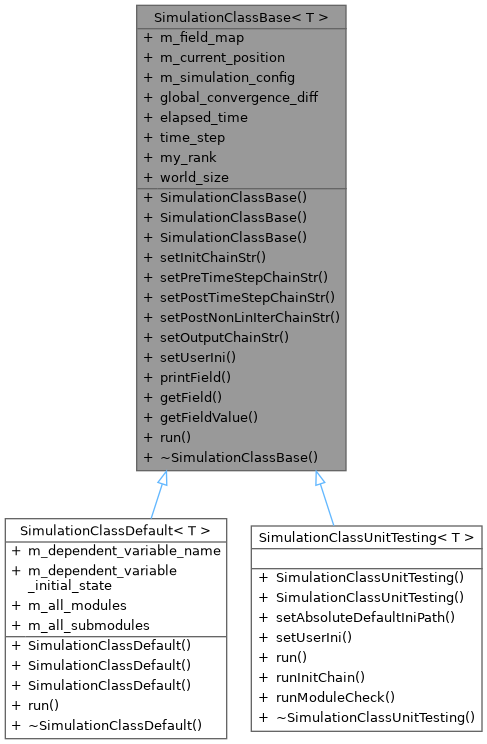
#include <SimulationClassBase.h>
◆ SimulationClassBase() [1/3]
◆ SimulationClassBase() [2/3]
Constructs a SimulationClassBase object and initializes its configuration.
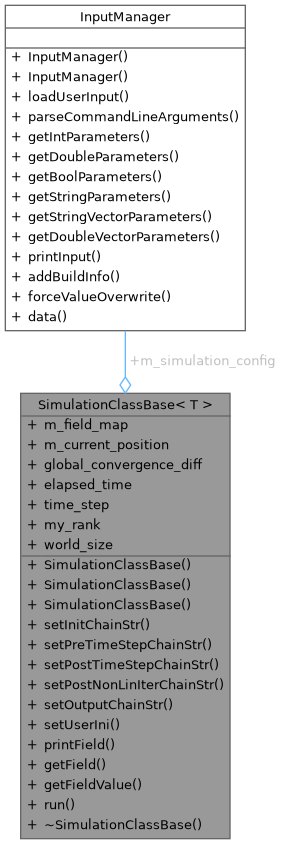
This constructor implements the command-line-driven configuration for the simulation by forwarding the provided argc and argv parameters to the internal simulation configuration object (m_simulation_config). It handles:
- Parsing the input
.ini file specified via the -i option.
- Applying any additional key=value overrides provided via the command line.
After construction, the simulation object is ready to run with a fully initialized configuration, combining the .ini file and any CLI overrides.
Usage: int main(int argc, char* argv[]) { SimulationClassBase<MySimType> sim(argc, argv); sim.run(); // Run simulation using parsed ini + CLI overrides }
- Template Parameters
-
- Parameters
-
| argc | The number of command-line arguments, typically passed from main(). |
| argv | The array of command-line argument strings, typically passed from main(). |
- Note
- The command-line parsing is entirely handled by
m_simulation_config.
- Users may provide multiple key=value overrides in the command line, e.g.,
./tpm -i config.ini param1=42 param2=foo.
- This constructor does not start the simulation; it only sets up the configuration.
◆ SimulationClassBase() [3/3]
◆ ~SimulationClassBase()
◆ getField()
◆ getFieldValue()
◆ printField()
◆ run()
◆ setInitChainStr()
◆ setOutputChainStr()
◆ setPostNonLinIterChainStr()
◆ setPostTimeStepChainStr()
◆ setPreTimeStepChainStr()
◆ setUserIni()
◆ elapsed_time
◆ global_convergence_diff
◆ m_current_position
◆ m_field_map
◆ m_simulation_config
◆ my_rank
◆ time_step
◆ world_size
The documentation for this class was generated from the following file:

 1.9.8
1.9.8