MoCSI
A fully Modular Computational Simulation Interface
Investigating the thermal surface environments of small bodies
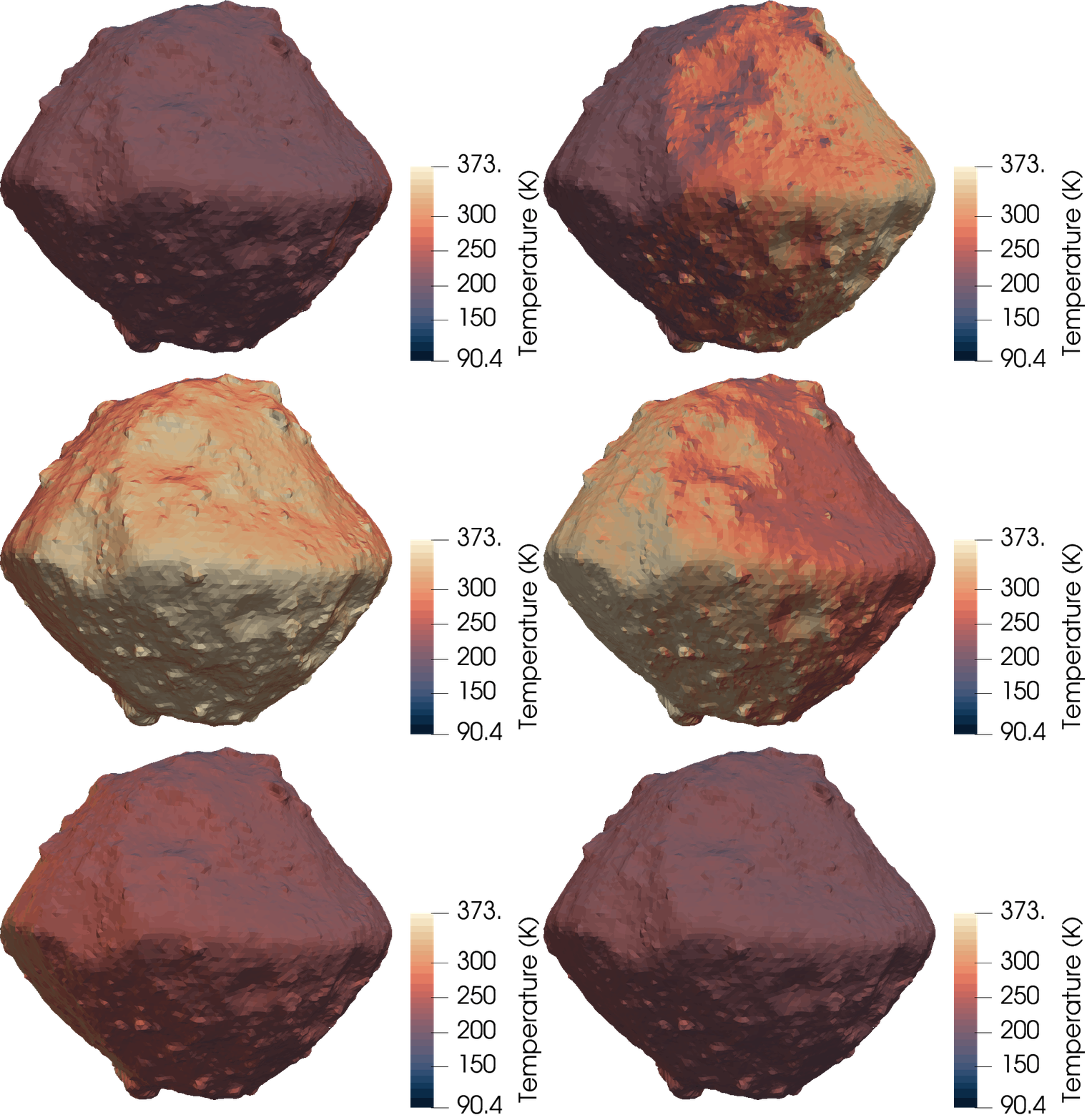
The fully Modular Computational Simulation Interface (MoCSI) solves the heat transfer equation for dry, airless planetary surfaces. At the core, MoCSI is a one-dimensional finite element method code, which can in principal run on a variety of geometries. In its current form, MoCSI can solve the heat transfer equation on each facet of any given shape model. What sets MoCSI apart from other thermophysical models is its highly modular architecture, which allows for easy adaptation to different applications and planetary bodies. Key physical properties – such as thermal conductivity, heat capacity, and density are managed by independent modules. This modular structure makes it straightforward to incorporate new or alternative formulations of physical parameters or mechanisms ensuring flexibility and extensibility. It is developed by Prof. Bastian Gundlach’s reseach group at the Institut für Planetologie at the University of Münster (see development team).
Features
1D FEM core that solves heat transfer on each facet of a shape model.
Swap physical properties and mechanisms through independent modules.
Scattered light and self-heating via the radiosity equations.
Run simulations directly on arbitrary small-body shape models.
Leverage NAIF SPICE for ephemerides and body-frame geometry.
See MoCSI in action across worked examples.